Next: 1.2 Jacobians Up: 1 Definitions Previous: 1 Definitions
For some problems, the observations are represented directly, either
as vectors in
 or as elements on a manifold with
 degrees of freedom. For example, observations of points in an
image are vectors in
degrees of freedom. For example, observations of points in an
image are vectors in
 (
( ). Observations of coordinate
transformations in 3D are elements of
). Observations of coordinate
transformations in 3D are elements of
 (
( ).
In these cases, we refer to the collective observation as
).
In these cases, we refer to the collective observation as
 .
Often the collective observation is built by stacking up
.
Often the collective observation is built by stacking up  independent
observations
independent
observations
 :
:
 |
 |
 |
(1) |
 |
|
 |
(2) |
The observation model
 predicts the value
of
predicts the value
of
 given the state parameters:
 |
(3) |
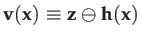
The error vector
 is then the difference (in a vector
space) between the observations and the predictions, as a function
of the parameters
is then the difference (in a vector
space) between the observations and the predictions, as a function
of the parameters
 :
:
When
is composed of independent observations
 ,
we can also refer to the corresponding pieces of
:
,
we can also refer to the corresponding pieces of
:
 |
|
 |
(5) |
 |
|
 |
(6) |
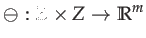
The operator  yields a vector difference between two elements
in
yields a vector difference between two elements
in  :
:
 |
(7) |
Its definition depends on that space. For observations in a vector
space (e.g. image points), is just the plain vector difference.
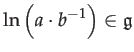
For a Lie group  , and two elements
  , we can define
where
 is the Lie algebra vector space corresponding
to .
is the Lie algebra vector space corresponding
to .
For some problems, the error function is easier to express directly,
rather than as a difference between observation and model prediction.
For instance, when estimating epipolar geometry, the errors are the
distances between points in an image and their epipolar lines. Each
distance
 is a scalar (
 ), though the points
themselves are 2-vectors and the predictions are lines. In such scenarios,
we refer to the error vector
), though the points
themselves are 2-vectors and the predictions are lines. In such scenarios,
we refer to the error vector
 without explicitly
defining it in terms of
and
.
Nonetheless, we still refer to the pieces
as observations.
without explicitly
defining it in terms of
and
.
Nonetheless, we still refer to the pieces
as observations.
We describe the uncertainty of
with a covariance matrix
 . In the case of Eq. :autorefequation4,
is typically just the covariance over
itself. Otherwise,
is computed by projecting uncertainties of the measured
quantities into the space of the error
. Again using
the epipolar geometry example, the covariance of each point measurement
is propagated through the distance-to-line function to yield variance
over the epipolar error.
. In the case of Eq. :autorefequation4,
is typically just the covariance over
itself. Otherwise,
is computed by projecting uncertainties of the measured
quantities into the space of the error
. Again using
the epipolar geometry example, the covariance of each point measurement
is propagated through the distance-to-line function to yield variance
over the epipolar error.
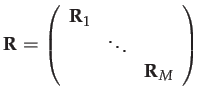
When the errors for each observation are independent, as is common
in many optimizations, the matrix
is block diagonal
with blocks, and we refer to the
 block as
 :
:
 |
(9) |
Ethan Eade 2012-02-16