


Next: 1.3 Parameter Perturbations Up: 1 Definitions Previous: 1.1 Observations
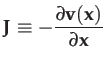
We define
 to be the negative Jacobian (differential)
of the error
to be the negative Jacobian (differential)
of the error
 as a function of
 :
:
 |
(10) |
We use the negative Jacobian because when
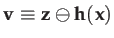 ,
it is more natural to compute the Jacobian of
,
it is more natural to compute the Jacobian of
 ,
and then
,
and then
 |
(11) |
As with
and
 , for independent errors the
whole Jacobian is just the stacked matrix of individual Jacobians:
, for independent errors the
whole Jacobian is just the stacked matrix of individual Jacobians:
 |
 |
 |
|
 |
 |
 |