


Next: 3.2 Levenberg-Marquardt Method Up: 3 Assuring Convergence Previous: 3 Assuring Convergence
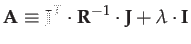
Define a modified information matrix, with a damping factor  :
:
 |
(32) |
As
 ,
,
 approaches the unmodified
information matrix. For
approaches the unmodified
information matrix. For
 ,
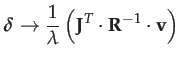
is dominated by the identity matrix. As increases, the
computed update
,
is dominated by the identity matrix. As increases, the
computed update
 tends to the scaled
gradient descent direction:
tends to the scaled
gradient descent direction:
 |
(33) |
 is not currently
at a minimum, increasing and computing the update
will eventually lead to a decrease in .
is not currently
at a minimum, increasing and computing the update
will eventually lead to a decrease in .
To control convergence behavior, we modify according to
a simple schedule, controlled by two factors  . Typical values
are
. Typical values
are  and
and  . Starting with parameters
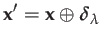
 , residual
 , and damping value , an update
 is computed and applied:
 |
(34) |
Then the residual
 is computed under the
new parameters. If the residual has decreased, such that
is computed under the
new parameters. If the residual has decreased, such that
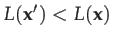 ,
then the update is valid, and the damping factor is decreased by factor
,
then the update is valid, and the damping factor is decreased by factor
 :
:
 |
 |
 |
(35) |
 |
|
 |
(36) |
If the residual has increased, or has not decreased by some threshold
amount, the parameters are left unchanged and is increased:
|
|
 |
(37) |
Thus only parameter updates that decrease the residual are kept. The
process is iterated similarly to the Gauss-Newton method, and can
be terminated when reaches a large threshold value (which
corresponds to a vanishingly small update). Note that in the case
where the parameter update is rejected and increases, the
information matrix and vector need not be recomputed. Instead only
the matrix
needs to be updated using the new
value, and the linear system solved to find a new
.
Ethan Eade 2012-02-16