Next: 1.4 Objective Function Up: 1 Definitions Previous: 1.2 Jacobians
Above, the operator  was defined for computing differences
in the observation space, in such a way that
was defined for computing differences
in the observation space, in such a way that
 is a vector in
 even when
 and
and
 are not represented as vectors. Similarly, we define the operator
 for ``adding'' a perturbation to our parameters. The
parameter space
for ``adding'' a perturbation to our parameters. The
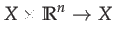
parameter space  could be a vector space like
 ,
or instead some other manifold with
,
or instead some other manifold with  degrees of freedom. For pose
estimation,
degrees of freedom. For pose
estimation,
 and
and  .
.
Consider a parameter perturbation vector
 .
Then for
.
Then for
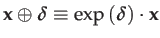
 , we have
 |
 |
 |
(12) |
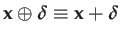
When
 , this is just standard vector addition:
 |
(13) |
When  for a Lie group
  , the perturbation is expressed as
left multiplication in the group:
, the perturbation is expressed as
left multiplication in the group:
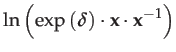
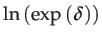
Thus in Lie groups, using Eqs. :autorefequation8 and :autorefequation14,
our intuition for and holds:
 |
 |
 |
(15) |
|
 |
(16) | |
|
 |
(17) |
In manifolds without the exponential map, the perturbation can be computed as an update that might violate the manifold constraints, followed by a projection back onto the manifold.
Ethan Eade 2012-02-16