Next: 2 Gauss-Newton Method Up: 1 Definitions Previous: 1.3 Parameter Perturbations
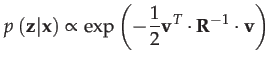
The goal is to adjust
 so that the likelihood of the
observations is maximized:
so that the likelihood of the
observations is maximized:
 |
(18) |
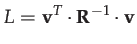
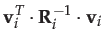
When the individual observations are independent, the covariance matrix
 is block diagonal. Then the objective function reduces
to a sum over the observations (again as a function of
):
is block diagonal. Then the objective function reduces
to a sum over the observations (again as a function of
):
The value of this objective function for some specific parameters
is often called the residual.
Ethan Eade 2012-02-16